Fisheye Lenses
Explanation
A bit of a different post this time. Last year, I shot primarily with normal 50mm lenses. I've may have mentioned this before, but I do think that 50mm is a really powerful and natural focal length to shoot at. Unlike other types of lenses, normal lenses have the property of rendering distances similarly to how our eyes naturally interpret and recognize distances. This is in opposition to wide angle lenses which spread and expand distances to make things look farther apart. Telephoto lenses, their opposite, compress space to make objects look closer together than they are. On another axis from focal lengths is distortion effects. For most lenses, especially normal and telephoto, there is little distortion and this is an expected and sought after trait. For most wide angles, this is also the case. However, there are classes of lenses where this distortion is entirely the point. And that's the point of this post, fisheye lenses.Fisheye lenses are generally a subset of ultra wide angle lenses where the "barrel distortion" is not meaningfully adjusted to make lines straight. This occurs more strongly toward the edges of the frame than in the center. This creates that bulging effect that is common in pictures taken with fisheye lenses that are not corrected for the distortion.
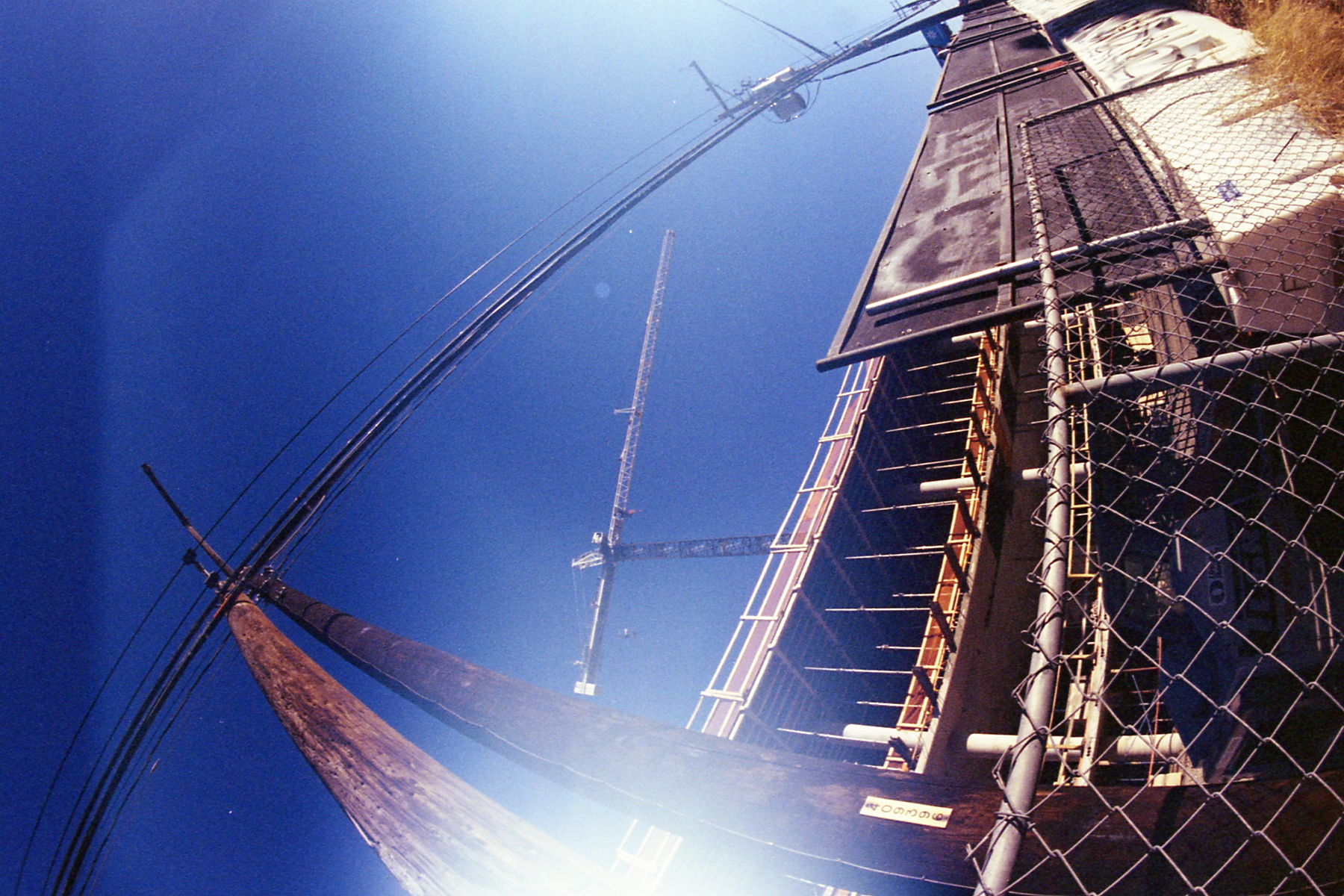
We can see this really clearly in the picture I've used for this post. Obviously, the poles are supposed to be, and in reality are, straight. In the center of the frame, the crane is straight. But, towards the edge of the frame, the pole to the left really strongly distorts and bends. Additionally, the fence bends downwards away from the center of the frame while the building's horizontal floors stay straight.
Ultimately, this is a bit of a gimmicky effect. It can be really hard to use fisheye lenses in a narrative manner that doesn't also distract. This is something that I definitely want to explore more deeply with this lens.
Talking more specifically about this lens, this is the lens I got all the way back in Nashville last September. I needed to wait until all the repairs were done on the Nikon to really be able to take it for a spin and I'm pleasantly surprised. Given that it's a used lens, it doesn't have all the things I would necessarily expect if I were to buy the lens new. Since you can't apply most normal filters to a fisheye lens like this due to its extreme curvature there are some filters included that attach to the back of the lens instead. This didn't come with those. There's also a small crack or defect on one of the internal elements. But it doesn't seem to affect the pictures in any meaningful way, at least not at the narrowest aperture available which is where this picture was taken. Overall, I'm ok with it because it meant I could get the lens for around $250 instead of close to $1000 new.
A couple of details that I found made shooting with this lens particularly odd or perhaps unexpected. Since this is a 16mm ultra wide angle lens, the angle of view is way wider than normal. It's to the point where if you're taking a picture at eye level, it's entirely possible your feet are in the picture if you're not paying attention. This also really distorts the z axis of the picture. One especially weird thing to look at is your arms if you extend an arm into the frame. It looks like it stretches out and extends a good foot or so longer than it should which is pretty odd. Oddly though, my perception when looking through the viewfinder didn't fully correlate to how the pictures came out. I experienced seeing less distortion, especially in the narrow direction of the frame than what ended up existing. For the picture in this post, I feel like while I did see some distortion along the x axis, it wasn't nearly as pronounced as how it actually turned out. The same was true in the opposite for the other direction.
There's definitely a lot more experimentation needed by me before I can really feel comfortable shooting with this lens effectively. That said, I do want to see how it performs in lower light conditions. Having a widest aperture of f2.8, it's not as wide open as the f1.4 or f1.7 50mm lenses which complicates shooting live music. It's already the case that even with those lenses and pushing film to a 1600 ISO equivalent, I'm getting shutter speeds around 1/30 or maybe 1/125 at the brightest venues. Stopping down to f2.8 would slow that down to 1/8 to 1/30 at best. All told though, motion blur and perfectly clear focus aren't things I find eminently important. So maybe it's fine and I should just proceed and attempt it anyways.